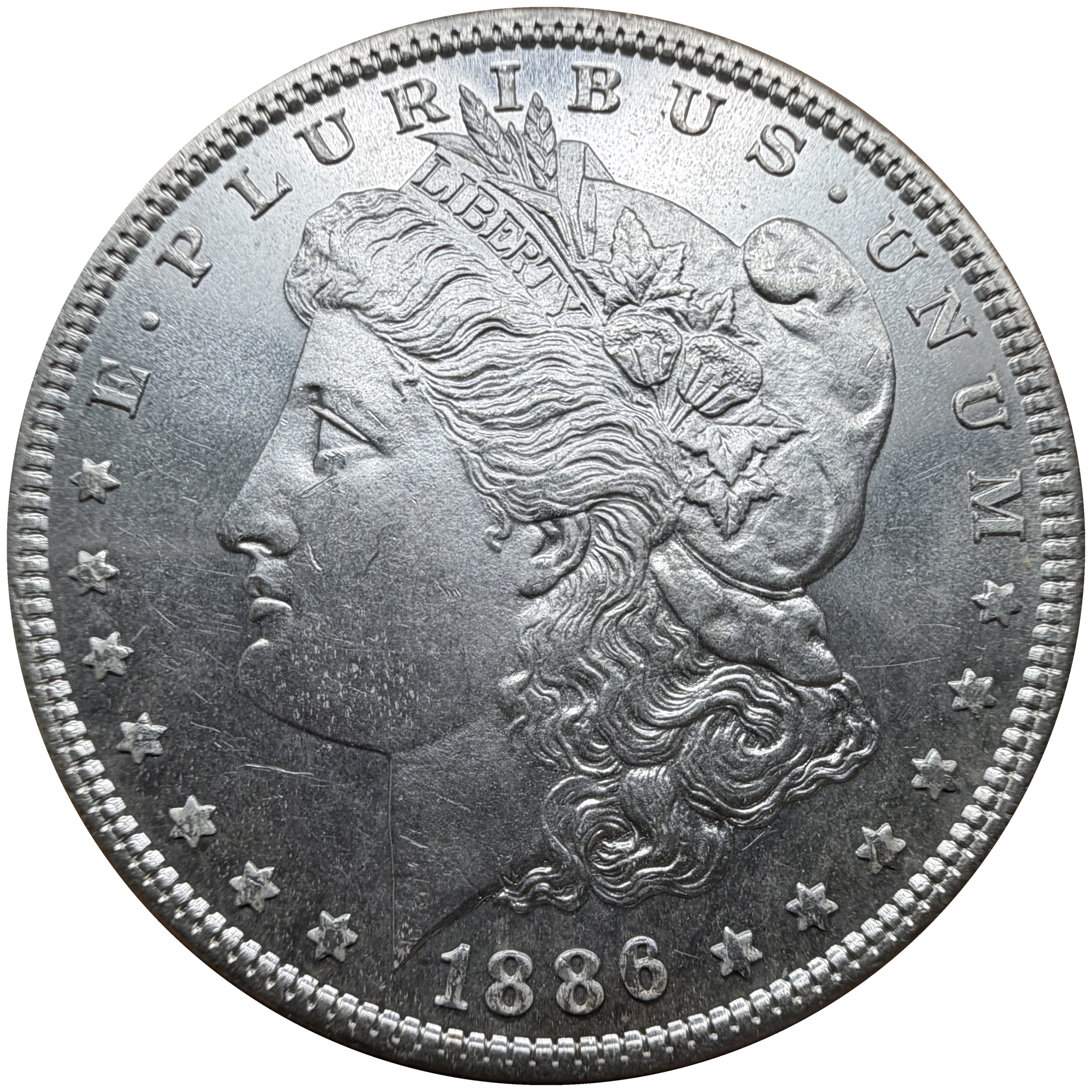

1886 Morgan Dollar
| Weight | 26.73 grams |
| Diameter | 38.1 mm |
| Mint | Philadelphia |
| Mintage | 19,963,886 |
| Edge | Reeded |
| Alignment | ↑↓ Coin |
| Composition | 90% Silver, 10% Copper |
| Melt Value | $65.77 (spot as of ) |
| Designer | George T. Morgan |
| Collector's Key ID | CK-4682 |
The 1886 Philadelphia, at 19,963,886 pieces, ran the highest P-mint Morgan Dollar output of the late-1880s production schedule and one of the largest single-year P-mint figures in the series. The Bland-Allison Act of 1878 sustained Treasury silver purchases at the fixed-price level, and Philadelphia carried an outsize share of the year's four-mint output as Carson City's contribution declined. The 1886-P carries the standard Reverse of 1879 hub configuration with no major sub-varieties anchoring the year's specialist collecting. The nearly 20-million mintage produced one of the deepest certified-pop Mint State distributions across the entire Morgan series.
Strike quality on the 1886 Philadelphia is exceptional and one of the cleanest-struck P-mint Morgan Dollars in the entire series. Liberty's hair detail, the eagle's central feathers, and the wreath all come up cleanly on most coins from early die states. Most surviving examples grade MS62 to MS66 from broken Treasury bag releases, with PCGS, the Professional Coin Grading Service, and NGC populations clustering at MS64 and MS65. MS66 is widely available and MS67 represents a meaningful condition tier, making the 1886-P one of the easier P-mint Morgan Dollars to acquire in MS66. The combination of high mintage and consistent die quality produced the broadest gem-grade pool of any 1886 mint.
The 1886 Philadelphia is a regular common date and the standard recommendation for a high-grade P-mint Morgan Dollar at modest cost. Pricing has held flat for two decades at the lowest end of the series price band. The 1886-P pairs with the 1885-P and 1887-P as the late-1880s P-mint trio that anchors the gem-grade Philadelphia entry pickup, with all three available in MS66 from post-1962 Treasury bag-release inventory at modest premiums. Mid-grade Philadelphia Morgan demand has held a flat pricing structure across two decades, with PCGS and NGC certified-pop distributions skewed heavily to the MS63 through MS65 range reflecting Treasury-release survival rather than pre-1950 preservation. Eye appeal at MS65 typically depends on early-die-state strike characteristics rather than the more common later-die-state features. For the Bland-Allison Act production context and the broader 1880-1890 production-pattern story, see the Morgan Dollar series history.
| Grade | Description | Typical Price |
|---|---|---|
| G-4 | Good (G) | $55–$64 |
| VG-8 | Very Good (VG) | $59–$68 |
| F-12 | Fine (F) | $63–$73 |
| VF-20 | Very Fine (VF) | $65–$75 |
| EF-40 | Extremely Fine (EF) | $68–$78 |
| AU-50 | About Uncirculated (AU) | $70–$81 |
| MS-60 | Uncirculated (MS) | $79–$91 |
| MS-63 | Choice Uncirculated (MS) | — |
This table is for educational purposes only and is intended to illustrate general market price trends and pricing steps between grades. Actual market conditions may vary significantly, especially for rarer pieces that often command premiums above the ranges shown here.
No major varieties are known for this issue.
View all Morgan Dollars varieties →- PCGS CoinFacts: Morgan Dollars
- NGC Coin Explorer: Morgan Dollars
- Heritage Auctions Archives
- Stack's Bowers Auction Archives
- A Guide Book of United States Coins (The Red Book)